
If your business accepts commercial, purchasing, or government purchasing cards and uses pre-authorizations, there’s an important part of the payment process that often gets overlooked.
Many merchants focus on submitting the required Level 2 or Level 3 processing data, assuming that’s all it takes to qualify for the best possible interchange rates.
However, the way pre-authorizations are handled before settlement can affect interchange qualification and ultimately what you pay to accept commercial cards.
Many merchants assume that if a transaction is approved, settled, funded successfully, and they’re submitting Level 2 or Level 3 data, every transaction is qualifying exactly as it should.
Unfortunately, that’s not always the case.
In fact, we’ve reviewed merchant statements where the issue wasn’t the processor’s pricing or missing Level 3 data—it was the way pre-authorizations were being handled before settlement.
What Are Pre-Authorizations?
A pre-authorization allows a merchant to verify available funds before the final transaction amount is known.
They’re commonly used by businesses such as:
- Home heating oil companies
- Moving companies
- Equipment rental companies
- Fuel distributors
- Field service organizations
- Businesses where the final invoice amount isn’t known until after work has been completed
For example, a merchant may pre-authorize a customer’s commercial card for $500 before providing a product or service. Once the work is completed, the final invoice totals $425.
The transaction settles.
The merchant gets paid.
Everything appears normal.
However, behind the scenes, that transaction may not have qualified at the lowest available interchange category.
Why Pre-Authorizations Can Increase Interchange Fees
Visa explains that, in most cases, the authorization amount and settlement amount should remain balanced.
When the settlement amount differs from the original authorization, the transaction could qualify at a higher interchange rate, be assessed authorization integrity fees, or increase chargeback risk.
For companies processing a significant volume of commercial card transactions, even small increases in interchange can become meaningful over time.
The challenge is that merchants rarely know it’s happening because the transaction still approves, settles, and funds successfully.
One of the First Things We Look For on a Merchant Statement
When we review a merchant statement, we don’t start by looking at the processor’s markup.
We start by looking at how commercial card transactions are actually qualifying at the interchange level.
If we notice an unusually high number of commercial card transactions qualifying at Standard or other higher-cost interchange categories, one of the first questions we ask is:
“Does your business perform pre-authorizations before the final invoice amount is known?”
That doesn’t automatically mean pre-authorizations are the problem.
Commercial card transactions can qualify incorrectly for several reasons.
Pre-authorizations are only one potential cause, but they’re one of the first areas we investigate because they’re often overlooked.
A Quick Gut Check
Did You Know?
A commercial card transaction can:
✔ Be approved
✔ Settle successfully
✔ Deposit funds normally
…and still qualify at a higher interchange category than expected.
Before assuming your commercial card processing is fully optimized, ask yourself:
- Do you regularly perform pre-authorizations before the final invoice amount is known?
- Have you noticed commercial card transactions qualifying at Standard or other higher-cost interchange categories?
- Have you ever seen authorization-related fees on your statement?
- Do you know whether your payment gateway updates authorizations when the final amount is lower than the original authorization?
If you answered “I’m not sure” to that last question, you’re not alone.
Most merchants have never had a reason to ask.
There isn’t an error message.
The payment still settles.
The only place the issue may appear is within your interchange qualification.
Why Level 3 Processing Doesn’t Always Guarantee the Best Interchange
Many companies invest significant time implementing Level 3 processing.
They make sure invoice numbers are transmitted.
They send tax amounts.
They include customer codes.
They submit detailed line-item information.
All of those things are important.
However, Level 3 processing is only one part of the overall transaction lifecycle.
Authorization handling is just one factor that can affect commercial card qualification. To learn more about how Level 3 processing works, visit our Level 3 Processing Guide.
If pre-authorizations aren’t handled correctly before settlement, merchants may still pay more than necessary—even when every required Level 3 data field is being submitted correctly.
A Real-World Pre-Authorization Example
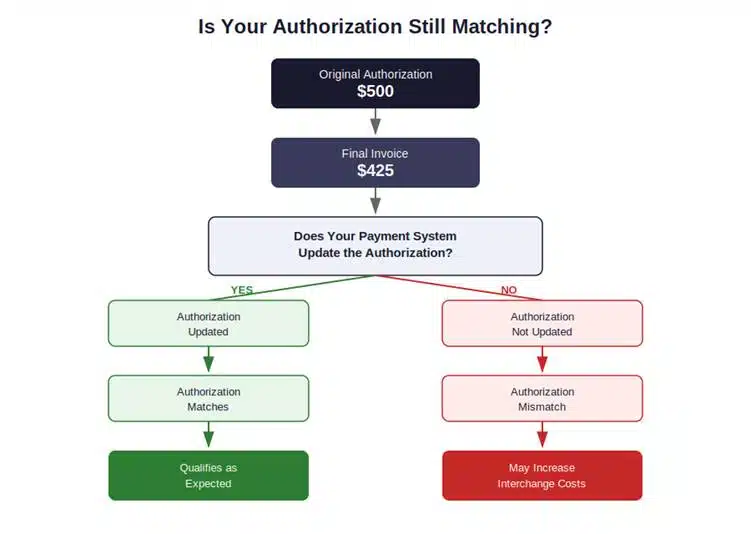
Imagine a merchant authorizes a commercial card for $500 before performing a service.
Once the work is complete, the final invoice totals $425. Questions? Give us a call today Revolution Payments 888 790 3450 or email info@ revolution-payments.com